Types of metal detectors are not variations of one idea; they solve different problems. A very low frequency (VLF) machine separates coins in a park. A pulse induction (PI) machine reaches deep in difficult ground. A long-range locator scans open terrain. A 3D scanner builds an image before anyone lifts a spade. Choosing the wrong family is the most expensive mistake in this hobby, because no amount of skill fixes a tool that is built for another job.
Quick comparison
| Type | Strength | Weakness | Best for |
|---|---|---|---|
| VLF | Target identification and separation | Loses depth in mineralized soil | Coins, jewellery, shallow relics |
| Pulse induction | Depth in bad ground and salt water | Limited discrimination | Deep relics, beaches, nuggets |
| Multi-frequency | Balance of depth and identification | Higher price and more settings | All-round hobby hunting |
| Ionic and long-range | Directional scanning of open ground | Needs stable terrain and practice | Reconnaissance, large areas |
| 3D imaging | Shape and depth before digging | Slow, steady scanning required | Deep structures, cavities, surveys |
Why the type matters more than the brand
Two devices can carry the same logo and behave like different tools. A detector optimised for iron rejection will frustrate you on a wet beach. A deep PI unit will drive you mad in a littered park. Start with the question: what does the ground contain, and what do I need to know before I dig? The answer points to a family, and only then to a model.
The five families explained
1. Very low frequency (VLF)
A VLF detector sends a continuous alternating field and measures how the return signal changes near metal. It identifies targets well, which is why it dominates coin and jewellery hunting. Its weakness is mineralized ground: iron minerals produce their own response and mask small or deep targets. If your soil is mild and your targets are shallow, VLF is efficient. If your soil is hot, it is not enough.
2. Pulse induction (PI)
A PI detector sends short, powerful pulses and measures the decay of the field. It ignores most ground mineralization and reaches deeper than VLF on large targets. The trade-off is discrimination: PI machines cannot tell a coin from a nail with the same confidence. They are the right choice for deep relics, saltwater beaches and gold fields where the ground defeats other technologies.
3. Multi-frequency
Simultaneous or selectable frequencies let one machine adapt to different targets and soils. Multi-frequency sits between VLF and PI in behaviour: good depth, useful identification and better stability in mixed ground. It is the most practical single-machine choice for a hobbyist who hunts in several environments.
4. Ionic and long-range locators
Long-range devices use directional antennas and sensitive receivers to scan a wide area and point toward an anomaly. The Xenon i2 adds Radar and O-Scope systems and a colour touchscreen to that workflow. These tools are for reconnaissance: they help you decide where to work. They are not a substitute for a close-range scan, and results improve with stable terrain, a slow sweep and a trained operator.
5. 3D imaging and gradiometer scanners
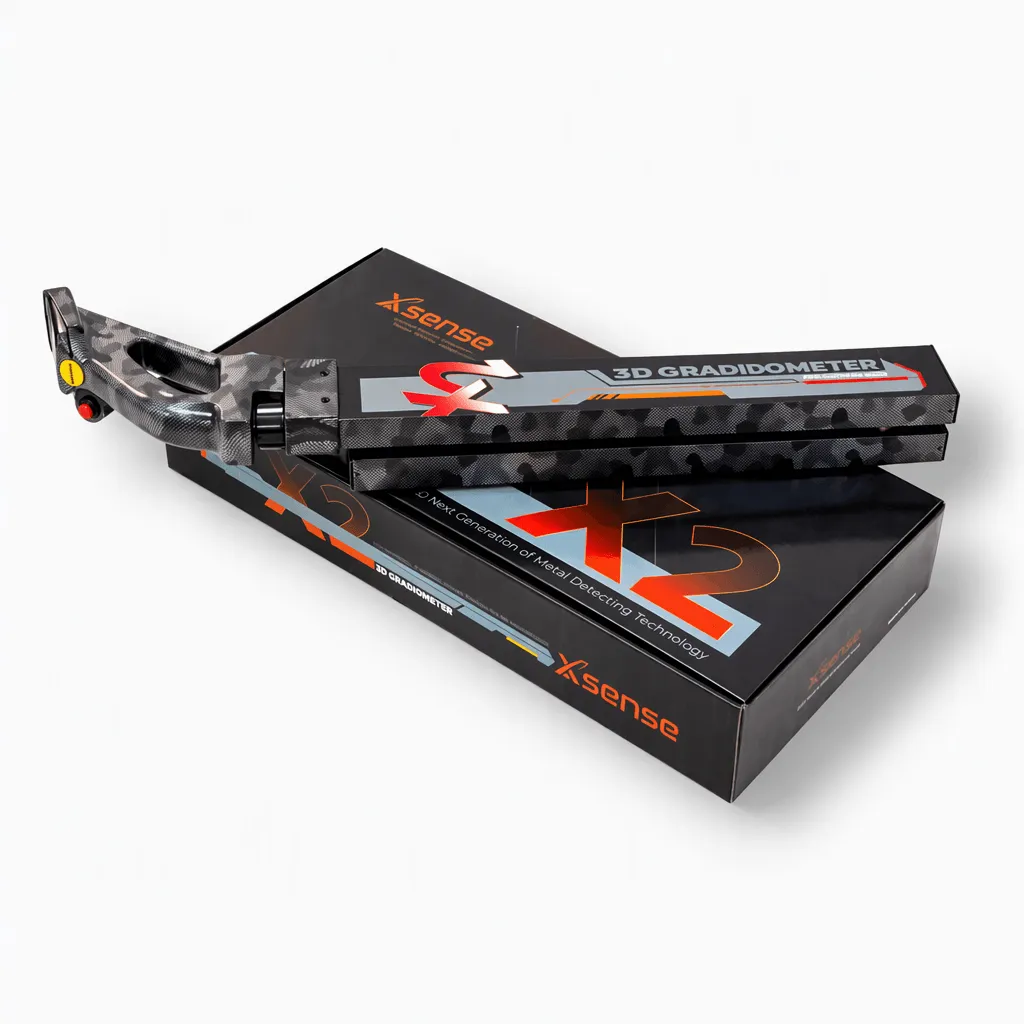
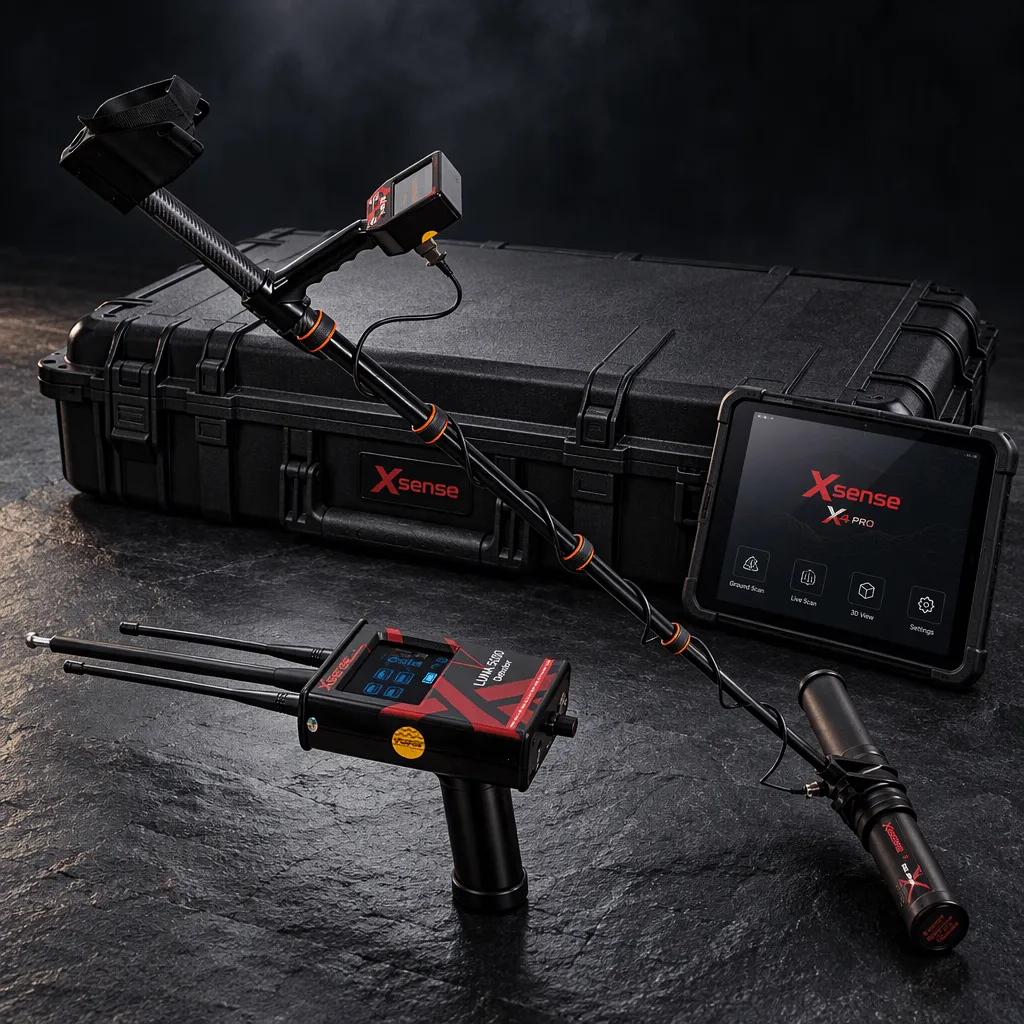
Imaging scanners measure changes in the local field and convert them into a map. The X1 uses a Super Gradiometer sensor; the X2 and X4 Pro use dual super sensors, with the X4 Pro adding a dedicated tablet and an on-device 2D display. The output is a subsurface model, not a photograph. You still interpret shape, depth and context, which is why training matters as much as hardware.
Side-by-side comparison
| Question | VLF | PI | Multi-frequency | Long-range | 3D scanner |
|---|---|---|---|---|---|
| Depth on large targets | Medium | High | Medium to high | Area dependent | High |
| Discrimination | Very good | Poor | Good | Limited | Visual |
| Mineralized soil | Weak | Strong | Good | Moderate | Good |
| Learning curve | Easy | Moderate | Moderate | Moderate to high | Moderate to high |
| Best first use | Parks and fields | Deep relics | Mixed terrain | Open reconnaissance | Structures and cavities |
Which type for which target
| Target | Recommended type | Why |
|---|---|---|
| Coins and small jewellery | VLF or multi-frequency | Fast separation and identification |
| Natural gold nuggets | High-frequency VLF or PI | Sensitivity to small targets and bad ground |
| Deep relics and caches | PI or 3D scanner | Depth plus context |
| Cavities, tunnels and rooms | 3D scanner | Shape and depth before digging |
| Large open areas | Long-range locator | Fast directional coverage |
| Water sources | Multi-mode long-range | Dedicated water mode |
Where the Xsense range fits
| Model | Type | Best for | Battery | Warranty |
|---|---|---|---|---|
| Xenon i2 | Ionic long-range | Directional reconnaissance with Radar and O-Scope | 10 h | Manufacturer warranty |
| Luna 5000 | Multi-mode long-range | Metals, cavities, gemstones and water | 10 h | 1 year |
| X2 | Dual-sensor 3D scanner | Balanced imaging and battery life | 20 h | 3 years |
| X1 | Super Gradiometer scanner | Deep targets and ergonomic field work | Up to 14 h | 3 years |
| X4 Pro | Professional dual-sensor scanner | Depth, speed and on-site reporting | 16 h | 3 years |
Can you combine two devices?
Yes, and professionals often do. A long-range locator narrows the search area; a 3D scanner confirms the anomaly and estimates depth; a conventional detector recovers the target. The Xsense workflow is built around this idea: scan wide, confirm the shape, then dig with evidence. Our guide to 3D ground scanners and the tutorial on reading 3D scan images explain the practical sequence.
Four mistakes in choosing a type
- Buying a deep PI machine for a trash-filled park.
- Expecting a long-range locator to replace a close-range scan.
- Treating a 3D image as a photograph instead of an interpretation.
- Ignoring the soil, which decides more than the brochure.
Frequently asked questions
Which type of metal detector is best for beginners?
A multi-frequency or a preset-rich long-range model is easier to learn than a professional scanner. The Luna 5000 is the most accessible entry in the Xsense range.
Is pulse induction deeper than VLF?
On large targets in mineralized ground, yes. On small targets with heavy trash, VLF usually identifies better.
Do long-range locators really work?
They are reconnaissance tools. They help narrow an area, but the result depends on terrain, technique and confirmation with a second method.
What does a 3D ground scanner show?
It shows changes in the subsurface field as a model of shape and depth. It does not show a photo of the object.
Can one device do everything?
No single technology wins in every soil and target class. Multi-mode devices cover more ground, but specialists still outperform them in extreme conditions.
Which Xsense model is best for deep relics?
The X4 Pro for depth with speed, or the X1 for a lighter, proven gradiometer workflow.
The bottom line
Choose the family that matches your target and ground, then the model that matches your budget and experience. The right type makes an average operator effective; the wrong type makes an expert fight the tool.
Next step: read the buying guide, compare 2026 prices, or ask an Xsense specialist.
Results depend on soil, target, settings and operator skill. Always follow local heritage and treasure laws and obtain the required permits.
Reviewed by the Xsense Detectors engineering team, Trabzon, Turkey. Last updated: 1 November 2026.